The network, drawn
74 vaults, 14 relationships. Every edge is real and directed, drawn from each vault’s governance — a consumer points at what it is built from, an org-vault at the children it contains, a successor at what it replaced. 59 vaults carry no cited relationship yet, so they sit unconnected here — that is honest topology, not missing data.
Each box is a vault, and names its class. A node is one computer
running one or more aDNA vaults, with a Home.aDNA vault that keeps track of them.
New here? Start with what the network is →
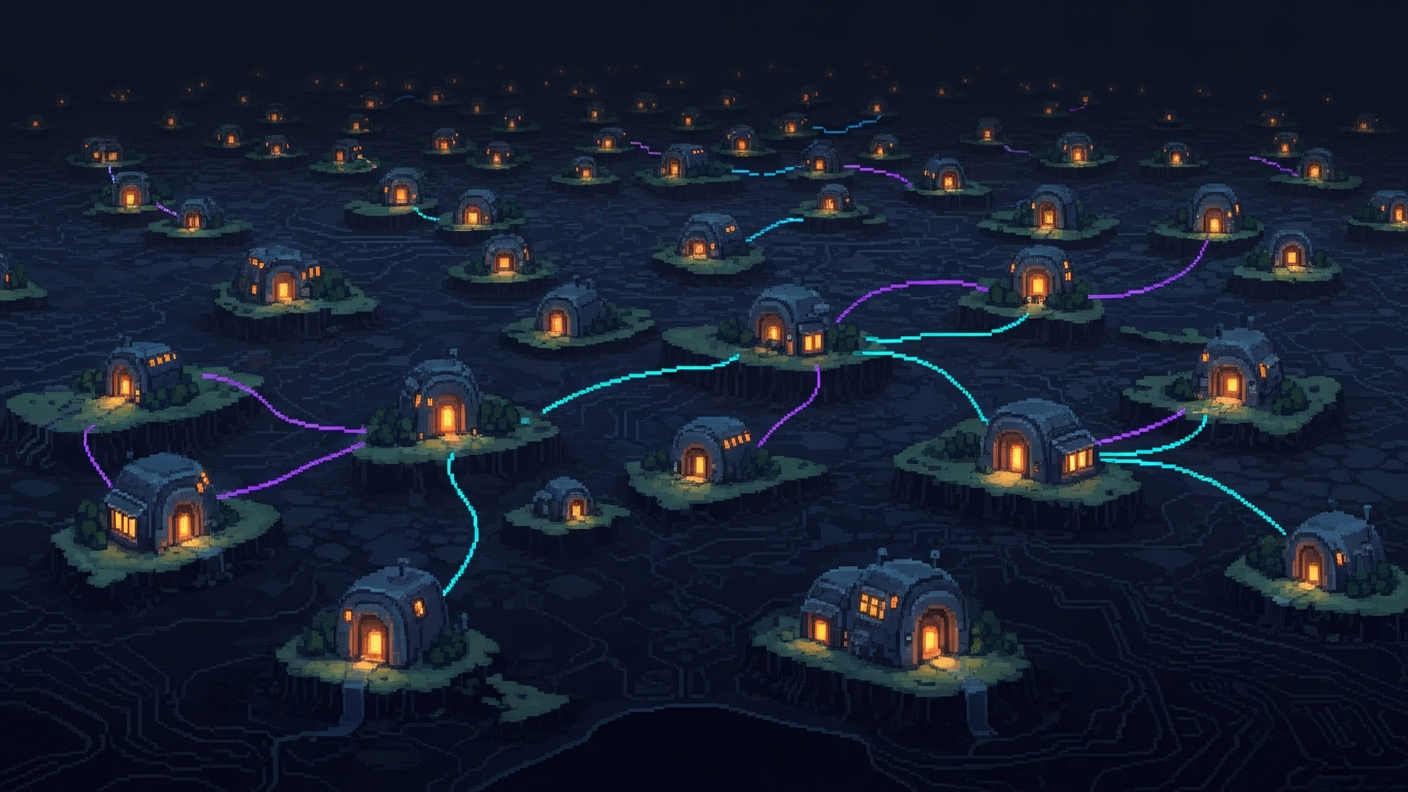
This is a context democracy, drawn: each project grows its own knowledge graph, and the graphs federate into a shared commons — narrowing from the whole network to the one vault you need is the convergence model at work.
How to read it
Line style = the kind of relationship
- umbrella · 1 — an org-vault contains its org-graph / pillar children
- federation · 9 — a consumer wrapper depends on the forge / framework it consumes
- partner · 0 — a platform ships with its default partner
- companion · 4 — a sibling persona-pair or thematic family
- supersedes · 0 — a successor replaced its predecessor (lifecycle)
Box colour
- A vault — every box shares one fill; its class is named on the box and listed below. The lines carry the story.
-
aDNA.aDNA— the standard this network documents.
Vault classes in view
- Platform · 36
- Forge · 9
- Framework · 7
- Org-Vault · 7
- Org-Graph · 4
- Genesis stub · 3
- Coordination · 1
- Framework (candidate) · 1
- Knowledge-graph · 1
- Network · 1
- Node (operational) · 1
- Standard · 1
- Tooling · 1
- Workspace · 1
Open any vault below — or browse them all on the vault index. Each vault page links back to this graph.